Showing posts with label Bush 41. Show all posts

Monday, July 31, 2017

White House Chiefs of Staff, 1969-2017

Below is a list of modern White House Chiefs of Staff (1969-2017) compiled for a book I am co-authoring on the topic.

Chief of Staff                                     Tenure             President                     Party
Harry Robbins (H.R.) Haldeman        1969-73           Nixon                          Republican
Alexander M. Haig, Jr.                       1973-74           Nixon                          Republican
Donald H. Rumsfeld                          1974-75           Ford                            Republican
Richard M. Cheney                             1975-77           Ford                            Republican
William Hamilton M. Jordan              1979-80           Carter                          Democratic
Jack H. Watson, Jr.                             1980-81           Carter                          Democratic
James A. Baker III                              1981-85           Reagan                                    Republican
Donald T. Regan                                 1985-87           Reagan                                    Republican
Howard H. Baker, Jr.                          1987-88           Reagan                                    Republican
Kenneth M. Duberstein                      1988-89           Reagan                                    Republican
John H. Sununu                                  1989-91           G.H.W. Bush              Republican
Samuel K. Skinner                              1991-92           G.H.W. Bush              Republican
James A. Baker III                              1992-93           G.H.W. Bush              Republican
Thomas F. McLarty III                       1993-94           Clinton                        Democratic
Leon E. Panetta                                  1994-97           Clinton                        Democratic
Erskine B. Bowles                              1997-98           Clinton                        Democratic
John D. Podesta                                  1998-01           Clinton                        Democratic
Andrew H. Card, Jr.                           2001-06           G.W. Bush                  Republican
Joshua B. Bolten                                 2006-09           G.W. Bush                  Republican
Rahm I. Emanuel*                              2009-10           Obama                         Democratic
William M. Daley                                2011-12           Obama                         Democratic
Jacob J. Lew                                       2012-13           Obama                         Democratic
Denis R. McDonough                         2013-17           Obama                         Democratic
Reinhold R. “Reince” Priebus            2017                 Trump                          Republican
John F. Kelly                                       2017-p             Trump                          Republican

* After Emanuel left his post to run for mayor of Chicago, Senior Adviser Peter M. Rouse served as interim chief of staff from October 1, 2010, to January 13, 2011.

Thursday, March 23, 2017

White House Deputy Chiefs of Staff, 1981-2017

Below is a list of individuals who have served as deputy chief of staff in the White House from 1981-2017. I compiled this information for the book I am co-authoring about the White House Chief of Staff and Office of Chief of Staff. This chart does not exist elsewhere as far as I know.

President
Chief of Staff
Deputy Chiefs of Staff[1]
Ronald W. Reagan
James A. Baker III
[01/20/81-02/02/85]
Michael K. Deaver [01/20/81-05/10/85]

Donald T. Regan
[02/02/85-02/27/87]
Michael K. Deaver [01/20/81-05/10/85]
W. Dennis Thomas [07/15/85-05/87][2]

Howard H. Baker, Jr.
[02/27/87-07/01/88]
Kenneth M. Duberstein [03/23/87-07/01/88]

Kenneth M. Duberstein
[07/01/88-01/20/89]
M.B. Oglesby, Jr. [07/05/88-01/20/89]
George H.W. Bush
John H. Sununu
[01/20/89-12/16/91]
Andrew H. Card, Jr. [01/20/89-02/03/92][3]
James W. Cicconi [01/89-01/91][4]

Samuel K. Skinner
[12/16/91-08/23/92]
Andrew H. Card, Jr. [01/20/89-02/03/92]
William Henson Moore, III [02/03/92-08/23/92]

James A. Baker III
[08/23/92-01/20/93]
Robert B. Zoellick [08/23/92-01/20/93]
William J Clinton
Thomas F. McLarty III
[01/20/93-07/17/94]
Mark D. Gearan [01/20/93-05/93]
Roy M. Neel [05/93-11/93]
Philip Lader [12/93-10/03/94]
Harold M. Ickes [01/03/94-01/20/97]

Leon E. Panetta
[07/17/94-01/20/97]
Harold M. Ickes (Policy and Political Affairs) [01/03/94-01/20/97]
Philip Lader [12/93-10/03/94]
Erskine B. Bowles (White House Operations) [10/03/94-01/11/96]
Evelyn S. Lieberman (White House Operations) [01/11/96-12/96]

Erskine B. Bowles
[01/20/97-10/20/98]
Sylvia M. Mathews [01/97-05/98]
Maria Echaveste [05/29/98-01/20/01]
John D. Podesta [01/97-10/20/98]

John D. Podesta
[10/20/98-01/20/01]
Maria Echaveste [05/29/98-01/20/01]
Stephen J. Ricchetti [11/98-01/20/01]
George W. Bush
Andrew H. Card, Jr.
[01/20/01-04/14/06]
Joseph W. Hagin (Operations) [01/20/01-07/20/08]
Joshua B. Bolten (Policy) [01/20/01-06/26/03]
Harriet E. Miers (Policy) [06/27/03-02/03/05]
Karl C. Rove (Policy) [02/03/05-08/31/07]

Joshua B. Bolten
[04/14/06-01/21/09]
Joseph W. Hagin (Operations) [01/20/01-07/20/08]
Blake L. Gottesman (Operations) [07/20/08-01/20/09]
Karl C. Rove (Planning) [02/03/05-08/31/07]
Joel D. Kaplan (Policy) [04/19/06-01/20/09]
Barack H. Obama
Rahm I. Emanuel
[01/20/09-10/1/10]
James A. Messina (Operations) [01/20/09-01/26/11]
Mona K. Sutphen (Policy) [01/20/09-01/26/11]

William M. Daley
[01/13/11-01/27/12]
Alyssa Mastromonaco (Operations) [01/27/11-present]
Nancy-Anne DeParle (Policy) [01/27/11-01/25/13]

Jacob J. Lew
[01/27/12-01/25/13]
Alyssa Mastromonaco (Operations) [01/27/11-present]
Nancy-Anne DeParle (Policy) [01/27/11-01/25/13]

Denis R. McDonough
[01/25/13-01/20/17]
Alyssa Mastromonaco (Operations) [01/27/11-05/14]
Anita J. Decker Breckenridge (Operations) [05/14-01/20/17]
Rob Nabors (Policy) [01/25/13-04/02/15]
Mark B. Childress (Planning) [01/12-05/22/14]
Kristie Canegallo (Implementation) [05/22/14-01/20/17]
Donald J. Trump
Reinhold R. “Reince” Priebus [01/20/17-present]
Joseph W. Hagin (Operations) [01/20/17-present]
Katie Walsh (Implementation) [01/20/17-present]
Rick A. Dearborn (Policy) [01/20/17-present]


[1] Unless otherwise indicated, staffers had the formal title “deputy chief of staff.”
[2] Official title was “Assistant to the President.”
[3] Official title was “Deputy to the Chief of Staff.”
[4] Official title was “Deputy to the Chief of Staff.”

Wednesday, January 22, 2014

Ohio, the Battleground States, and Candidate Visits During the 2012 Presidential Election

Here is some travel data from the 2012 presidential election. As you can see, Ohio led the way in combined candidate travel, followed by Virginia, Florida, Iowa, and Colorado.

Battleground state travel for 2012:

Obama Biden Obama-Biden Total Romney Ryan Romney-Ryan Total Campaigns Combined
CO 15 1 16 7 8 15 31
FL 15 4 19 13 9 22 41
IA 12 3 15 11 7 18 33
MI 2 0 2 2 1 3 5
MN 1 0 1 0 1 1 2
NV 10 1 11 5 4 9 20
NH 7 1 8 6 2 8 16
NM 1 0 1 1 0 1 2
NC 5 1 6 3 0 3 9
OH 21 3 24 15 16 31 55
PA 2 0 2 4 2 6 8
VA 21 3 24 11 9 20 44
WI 8 3 11 3 3 6 17


First term travel by POTUS to Ohio has steadily increased since the early 1980s:

Reagan 9
Bush 41 18
Clinton 18
Bush 43 30
Obama 37

Thursday, November 29, 2012

The Obama-Romney Post-Election Meeting: No Bromance Expected


Politico Arena Topic: A Romney-Obama Friendship?

The meeting between Governor Mitt Romney and President Barack Obama is the political equivalent of two head coaches of rival sports teams shaking hands after the conclusion of a heated game. Just like the Yankees and Red Sox or Packers and Bears, the handshake means nothing except to signify that at the end of the contest, the combatants can be somewhat civil towards each other but the rivalry will continue.

Unlike John McCain who continued in his capacity as a U.S. Senator following his 2008 defeat, Mitt Romney has no position in government and thus will have absolutely no impact on policy or politics. Democrats won’t need to listen to him and Republicans won’t want to.

I also do not foresee Obama and Romney becoming bosom buddies down the road as Gerald Ford and Jimmy Carter or George H.W. Bush and Bill Clinton did. The 2012 election was a particularly bitter contest (not that all presidential elections aren’t tough) and both candidates seemed to have a high level of disdain for one another. In the end, the meeting will make for a nice photo-op but will disappear quickly from the public consciousness as focus will turn back to the fiscal cliff Washington is staring at through the windshield.

Permalink to Politico Arena comment

Tuesday, August 7, 2012

Veepstakes: The Case for Portman


Politico Arena Topic: Romney's Running Mate

Picking a running mate is the most important decision a presidential candidate can make. After all, they are not the president yet; they cannot order a military strike on a foreign country, cannot send American soldiers into harm’s way in a foreign land, cannot issue executive orders or sign bills into law. About the only thing of consequence a presidential candidate can do is pick the individual who will serve as their deputy should they be elected. It used to be that the vice presidential position was so inconsequential that it was the place where political careers went to die. In the modern presidency, however, vice presidents have become an important component of the presidential administration and a trusted adviser to the president. But the most important role of the vice president has remained timeless—to be ready to take over in the event that death or disability strikes the president. This transition has happened eight times in our history due to the death of the president and once due to resignation. However, too often in American history, presidential candidates (or the party machine in days gone by) have failed to ask a fundamental question when considering the person who will be only a heartbeat away from the presidency: is this person qualified and competent to be president in their own right?

With the pressure to win being paramount, running mates are often chosen because of geographical and ideological reasons, qualifications and competence be damned. Senator John McCain’s recent defense of his own 2008 decision aside, Sarah Palin was not qualified to be president. The world held its collective breath in 1992 when President George H.W. Bush collapsed in Japan as, just for a moment, the thought of “President Dan Quayle” took hold. And Spiro Agnew’s resignation as vice president after a lengthy investigation into his ethical and legal misdeeds allowed the country to avoid an even bigger Constitutional crisis when his boss Richard Nixon resigned a year later. These examples should cause presidential candidates to pause and reflect during the search for their running mate.

And so that brings us to Governor Mitt Romney’s decision about his own running mate. The usual cast of characters have been mentioned for months as speculation has continued nonstop since the spring: Chris Christie, Bobby Jindal, Tim Pawlenty, Rob Portman, and Paul Ryan. I do think it will be somebody from this group. All of these folks are relatively safe—there is not a Palin in the bunch. If the 2012 election were a football game, it is likely to be decided by a field goal, not a touchdown. Thus Romney does not need a Palinesque Hail Mary; rather, a short, high-percentage pass down field to get him into field goal range would be much more helpful. And Romney does not seem to be a gambler anyway—he is much more Aaron Rodgers than Brett Favre.

Given this, my gut and my head scream Rob Portman, the Ohio Senator no one knows much about. In terms of geography, Portman comes from perhaps the most important state of all in 2012—Ohio. No Republican has ever won the presidency without winning Ohio and only twice since 1896 has a Democrat achieved that, the last time being 1960. You win Ohio, you win the presidency. Portman, a longtime member of the U.S. House from Southwest Ohio, would help Romney in the state. Portman’s only downside in the Buckeye State is that he is relatively unknown to most Ohioans. But that is what a campaign is for and by the time November rolled around, most Ohioans would have an idea of who Portman is. Ideologically, Portman is a conservative, but not the kind of flamethrower that would turn off independent, swing voters. He is a soft spoken, pleasant, policy-wonkish individual that has proven he can work with individuals across the ideological and political spectrum. He will not excite the base in a Palineque sort of way, but he will not turn them off either.

And if Governor Romney considers the competent/qualified question I laid out above, no one on the list of frontrunners for veep comes close to Portman. He is absolutely qualified to be president—in fact much more so than Governor Romney himself. His resume, filled with a variety of experiences in the White House and on the Hill, is as strong as any president since George H.W. Bush. Besides spending 12 years in the U.S. House of Representatives and currently serving in his first term as a U.S Senator, Portman has held a variety of positions in the administrations of both Bushes including as an Associate White House Counsel, director of the White House Office of Legislative Affairs, U.S. trade ambassador, and director of the Office of Management and Budget. This is a better resume than most presidential candidates and if Romney fails to capture the White House in 2012, Portman would have to be considered a likely POTUS candidate in 2016. Romney, of course, may choose to go in a different direction. But if he is serious about picking the best person for the job, he need not look beyond the Buckeye State for his veep.

Permalink to Politico Arena comment

Saturday, July 14, 2012

Obama's Swing State Travel Log

During presidential election years, I get asked by the media quite a bit about Ohio's role as a battleground or swing state. Besides the fact that Ohio is known as the "Mother of Presidents" with a direct connection to 8, in the modern era Ohio maintains its strategic importance to fashioning an electoral vote majority. If it wasn't important, presidential contenders and their campaign surrogates wouldn't visit Ohio as much as they do.

This concept of presidential travel and the electoral map motivated me to actually look at the data. What I present below is just a first swipe--I haven't drilled down into the numbers much. And, this is the beginning of what I hope will be a long-term project tracking the travel destinations of presidents, presidential candidates, and their surrogates.

President Obama's First Term Travel to 13 Swing States I have identified for 2012 election (as of July 13, 2012):*

Colorado: 10/4
Florida: 18/5
Iowa 10/4
Michigan 10/3
Minnesota: 6/1
Nevada: 10/4
New Hampshire: 6/2
New Mexico: 3/1
North Carolina: 10/3
Ohio: 22/6
Pennsylvania: 19/2
Virginia: 49/9
Wisconsin: 8/1

*First number is total separate trips to state; second number is separate trips to state in 2012 so far.

Although Virginia is the most visited battleground state by President Obama, many of those visits were in conjunction with his role as Commander-in-Chief and other official duties (e.g. visits to the Pentagon, CIA, etc.). Also, given Virginia's proximity to the White House and ease of travel to get there, it is unsurprising that it ranks first.

Ohio, it should surprise no one, ranks second, with Pennsylvania close behind. Obama has made 22 total visits to the Buckeye Battleground and 6 in 2012 alone with another one scheduled for this coming Monday in Cincinnati.

Another question intrigued me: how does Obama's travel to Ohio compare to other recent presidents in their first term? I did a quick check and here's what I came up with:

Reagan: 9
GHW Bush: 18
Clinton: 18
GW Bush: 30

It seems that even as Ohio's electoral vote totals have declined over time, Ohio is becoming increasingly popular with sitting first-term presidents.

More to come on this topic as the campaign season rages on.

Tuesday, June 12, 2012

Jeb Bush, Grover Norquist, and the Chickens Coming Home to Roost

Politico Arena Topic: Is Jeb Bush Right About Partisanship?

Governor Jeb Bush is absolutely correct when he says that Presidents Ronald Reagan and George H.W. Bush would be out of sync with today’s GOP. Make no mistake, Reagan and Bush were conservatives; however, both were willing to negotiate, compromise, and cut deals with the other side, despite differences in ideology and policy. Such behavior is considered treasonous today but governing was the priority, not the 24/7/365 campaign that dominates in the twenty-first century.

One can see in the Bush 41 presidency a foreshadowing of what would come: when he agreed with Democrats to raise taxes in the Omnibus Reconciliation Act of 1990 in an attempt to get America’s fiscal house in order and lower the deficit, he was assailed by the Right for discarding the “No New Taxes” pledge he made at the 1988 RNC Convention. In this instance, Bush acted with courage and did what he thought was in the best interests of the country. However, conservatives at the time such as Richard Viguerie assailed President Bush accusing him of abandoning conservative principles and being too willing to “cut deals with the Washington establishment.”

Today, the chickens have come home to roost. Most Congressional Republicans have signed Grover Norquist’s pledge not to raise taxes—ever. Republicans fear if they don’t sign the Norquist pledge, he will find someone who is willing to sign the pledge to defeat them in the next primary election. And with the Congressional map gerrymandered in such a way that most districts are safe, and with the invention of the SuperPAC and unlimited campaign spending, Republican members of Congress fear a primary challenge from an uber-funded fellow Republican more than anything. And so to avoid that primary challenge, Republican lawmakers uphold Conservative orthodoxy—regardless of merit and regardless of the consequences thus giving us stalemate.

Permalink to Politico Arena comment

Saturday, June 4, 2011

Lawrence Eagleburger, Professional Diplomat, R.I.P.


Lawrence Eagleburger, a longtime diplomat and former Secretary of State during the George H.W. Bush Administration, passed away at the age of 80. A Milwaukee, Wisconsin native, he was the first career foreign service officer to rise to the post. For those of us who came of age during Operations Desert Shield and Desert Storm, Eagleburger was a constant presence in the media as Secretary of State James Baker's deputy during that period.

Perhaps his toughest assignment was when he was tasked with convincing Israel to not retaliate during the Persian Gulf War as Iraqi scud missiles rained down on that country. He succeeded thus keeping the delicate coalition together that was constructed by President Bush to remove Iraq from Kuwait. Here is how the New York Times described his efforts:

"During the first Bush presidency, Mr. Eagleburger was second in command at the State Department under James A. Baker III, and because of his previous experience in the Middle East as Mr. Kissinger’s aide, he was sent on a delicate mission to Israel in 1991, at the start of the Persian Gulf war, which had been mounted to eject Iraq from Kuwait. Mr. Eagleburger’s task was to persuade the Israelis under Prime Minister Yitzhak Shamir to stay out of the fight, even though Iraqi Scud missiles were landing in Israel. The United States was concerned then, as it would be 12 years later in the war in Iraq, that Israel not be seen as a military partner, fearing that such a perception would alienate Arab and Muslim states willing to help. His success eventually led to his appointment as secretary of state."

He was one of the smartest foreign policy guys around. He will be missed.

Thursday, February 24, 2011

Huck for Prez in 2012?


Politico Arena Topic: Could Huckabee Win in 2012?

First, Mike Huckabee deserves a lot of credit for defending Michelle Obama and her campaign to decrease childhood obesity in this country and opposing the Limbaugh crowd’s vicious attacks. I do think if he is able to raise enough cash that he would be a formidable contender for the GOP nomination. People forget that in 2008 he lasted longer than any other Republican presidential contender except John McCain. As a former governor from Arkansas, Huckabee has a natural advantage over many other potential Republican candidates in those crucial Southern primary states.

Could he beat President Obama in 2012? Sure it’s possible but almost two years out it’s impossible to predict what will happen. In 1991, President George H.W. Bush was so popular and looked so invincible that most big name Democrats refused to throw their hat in the ring. In 1995, many observers were convinced that Bill Clinton would be a one term president. Well, Bush was beaten by Clinton in 1992 and Clinton rolled on to reelection in 1996.

Permalink to Politico Arena comment.

Saturday, December 4, 2010

The Politics of New START and the Echo of Jesse Helms


The New START Treaty (what should really be called START III), a treaty that would reduce the nuclear stockpiles of the U.S. and Russia to historically low levels, should have sailed through the Senate with bipartisan support. After all, most arms control treaties do just that. Politics stops at the water's edge...at least it used to. Just look at the list of arms control/defense treaties since 1963:

• Limited Test Ban Treaty, 1963 -- 80-19.
• Non-Proliferation Treaty, 1969 -- 83-15. (7 Democrats and eight Republicans voted against.)
• Latin American Nuclear-Free Zone Treaty, 1971 -- 70-0.
• Seabed Arms Control Treaty, 1972 -- 83-0.
• Anti-Ballistic Missile Treaty, 1972 -- 88-2. (U.S. later withdrew.)
• Biological Weapons Convention, 1974 -- 90-0.
• Intermediate-Range Nuclear Forces Treaty, 1988 -- 93-5.
• Peaceful Nuclear Explosions Treaty and Threshold Test Ban Treaty, 1990 -- 98-0 (to ratify both treaties).
• Conventional Armed Forces in Europe Treaty, 1991 -- 90-4.
• Strategic Arms Reduction Treaty, also known as START I, 1992 -- 93-6. (Expired 2009.)
• Strategic Arms Reduction Treaty II, also known as START II, 1996 -- 87-4.
• Chemical Weapons Convention, 1997 -- 74-26 (with 29 Republicans joining 45 Democrats in voting yes and 26 Republicans voting no.).
• Strategic Offensive Reductions Treaty, also known as the Moscow Treaty, 2003 -- 95-0.

Even divided government has not been an impediment to passing arms control treaties. As reported by PolitiFact: "Thirteen of the 14 treaties above were ratified when one party held the presidency and the other party held the Senate." Only the 1997 Chemical Weapons Convention, a treaty negotiated under Reagan and G.H.W. Bush and signed under Clinton, did not sleepwalk through the Senate and that was largely because of the opposition of Senator Jesse Helms (R-NC), the Senate Foreign Relations Chair. Few members of Congress were more ideological or partisan than Helms an the 1990s--a conservative ideologue whose hatred for President Bill Clinton was unmatched. Still, despite Helms' attempts to sabotage the treaty, it mustered a 74 votes, more than enough to pass the 2/3 threshold.

So what's the problem with New START? Actually little unless you are a sitting Republican Senator more interested in political gamesmanship than U.S. national security. There is a reason that just about every establishment Republican and Democrat has lined up in support of the treaty. Such well-respected party luminaries on both sides of the aisle as James Baker, Henry Kissinger, Brent Scowcroft, William Cohen, Madeline Albright, and Colin Powell, have publicly committed to supporting the New START Treaty and the Obama administration in this endeavor. Even Senator Richard Lugar (R-IN), the ranking member of the Foreign Relations Committee has staked his political career and opened himself up to a primary challenge for his strong support of the treaty. Why? Because Lugar always puts principle above party and it's one of the reasons why he is beloved by so many on both sides of the aisle.

All of this has not stopped Senator Jon Kyl (R-AZ), the Republican Whip, from attempting to scuttle the treaty and deny President Obama a foreign policy victory. His intransigence is a reminder that current day senators cast in the mold of Jesse Helms are omnipresent in the 21st Century Senate. In fact, Kyl was one of Helms' compatriots opposing the Chemical Weapons Convention in 1997. The real shame is that the Senate, in the eyes of James Madison, was supposed to be the body of maturity and coolness to offset the passions of the more unruly House. In 2010, however, both chambers resemble twins, dedicated to partisanship and political oneupsmanship at the expense of the national good.

In the end, New START will likely pass but not without an already unacceptable delay. Because the original START Treaty expired in December 2009, American inspectors are no longer on the ground in Russia. Every day that passage of New START is delayed is yet another day where American inspectors do not have access to Russia's nuclear stockpile and American national security is at greater risk.

Monday, November 23, 2009

To Bow or Not to Bow, That is the Question


The president had this to say about "the bow" to Japanese Emperor Akihito:

"I’m representing the United States of America. And we’re talking about a friend, and we’re talking about an ally. We’re talking about a nation with whom we have constructive relationships."

That wasn't President Barack Obama saying that about his recent bow to the Japanese Emperor. That was President George H.W. Bush saying that in 1989 in response to a reporter's query about his bow to the new Japanese Emperor.

Presidents bow. President Richard Nixon did so when he visited China and bowed to Mao Tse-Tung. President Obama did so when greeting the Saudi King and the same Japanese Emperor. Presidents even hold hands with other leaders, as President George W. Bush did with Saudi King Abdullah (I didn't hear the Veep complaining about that).

Despite what former Vice President Richard Cheney said, it's really not a big deal. Presidents of both parties bow. It's a sign of respect in many cultures. Just because we don't do it in America doesn't mean it signals weakness when an American president bows to a foreign leader, especially an ally. Now, if they had curtsied, that might be another story...


Wednesday, August 19, 2009

The Vacationing President

CBS News' Washington Unplugged has a 15 minute segment on the history of modern presidents and their vacation habits. It's a cool watch.

Interesting tidbit: President George H.W. Bush could play 18 holes of golf in 90 minutes. If true, that's almost unheard of. I wonder what his average score was.


Watch CBS Videos Online

Hat Tip: Political Wire

Friday, July 24, 2009

Tracking Supreme Court Nomination Votes in the U.S. Senate, 1789-Present


The U.S. Senate has a site which tracks all votes on Supreme Court nominations from 1789 to the present day. The site contains a bevy of information and I highly recommend it to anyone interested in the topic.

Neither of George W. Bush's nominees coasted to the bench and faced similar criticisms from the Democrats:

Alito's vote total: 58-42
Roberts' vote total: 78-22

Bill Clinton's nominees faced little opposition:

Breyer's vote total: 87-9
Ginsberg's vote total: 96-3

George H.W. Bush had a mixed record. Souter was a slam dunk; Thomas squeaked by:

Thomas' vote totals: 52-48
Souter's vote totals: 90-9

Reagan was 4-1 as Bork went down to defeat, the last time a nominee failed in a U.S. Senate vote:

Kennedy's vote totals: 97-0
Bork's vote totals: 42-58
Scalia's vote totals: 98-0
O'Connor's vote totals: 99-0
Rehnquist's vote totals for elevation to chief justice: 65-33

I really do think the political environment has changed. Scalia and Ginsberg combine for a 194-3 vote? Can you imagine either justice sailing though in the 21st century? Ideology is now used as a litmus test. It shouldn't be.

Wednesday, March 18, 2009

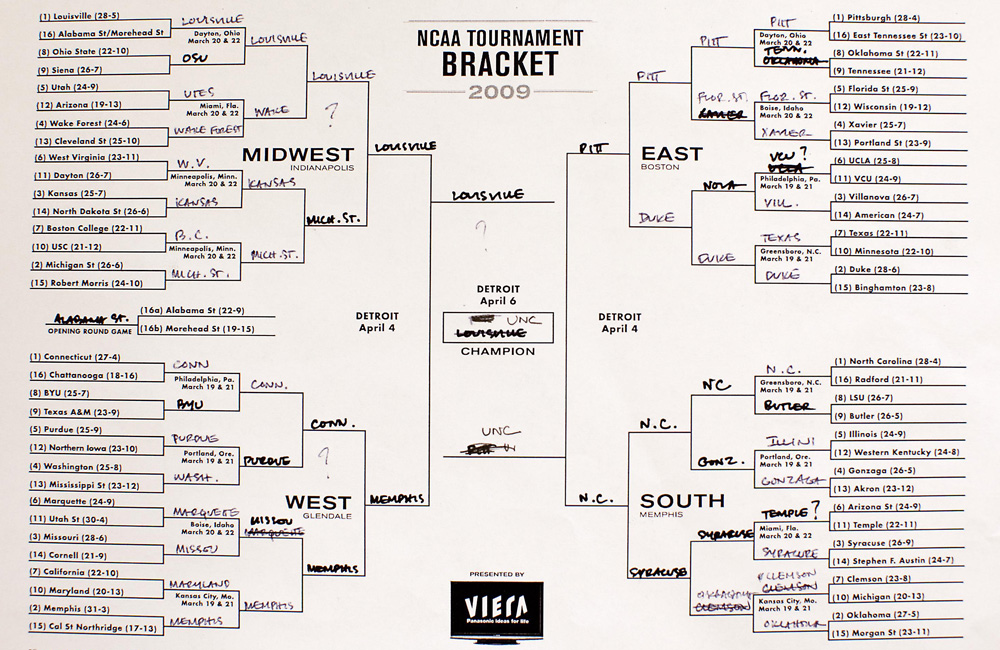
Obama Afflcited With March Madness


How cool is this? The Commander-in-Chief fills out an NCAA Tournament Bracket for all the world to see. Does it publicly. What would Lincoln have done? More importantly, would Lincoln have taken UNC as well, or gone for the home state Fighting Illini? Is the bracket covered under the Presidential Records Act of 1978? Does it go into the archives?

Seriously though, filling out an NCAA basketball tourney bracket is something millions of Americans do each year. For some, there is no better time in sports than that known as March Madness. I, for one, am not afflicted with the disease--basketball has never been my game (being short and shaped like a pear doesn't help). However, this President clearly enjoys sports and is determined to continue being a fan even from the cloistered Oval Office.

Most of our recent presidents have been sports fans: Nixon, Ford, the Bushes, and Clinton to name a few. Obama fits firmly in that group. What I find intriguing is that he is unapologetic about his preferences (he's an avid White Sox fan and hates the Cubbies) and enjoys the game from a lay person's perspective--he plays pick-up basketball whenever he can, and sat with the fans at a recent NBA game and enjoyed a cold one. Regardless of what your party ID is, if you like sports, you have to admit, that's pretty cool.

White House.gov Photo Gallery Feed

White House.gov Blog Feed

White House Flickr Photostream

Site Meter

WIKIO

Wikio - Top Blogs - Politics

Followers