Showing posts with label Nixon 37. Show all posts

Monday, July 31, 2017

White House Chiefs of Staff, 1969-2017

Below is a list of modern White House Chiefs of Staff (1969-2017) compiled for a book I am co-authoring on the topic.

Chief of Staff                                     Tenure             President                     Party
Harry Robbins (H.R.) Haldeman        1969-73           Nixon                          Republican
Alexander M. Haig, Jr.                       1973-74           Nixon                          Republican
Donald H. Rumsfeld                          1974-75           Ford                            Republican
Richard M. Cheney                             1975-77           Ford                            Republican
William Hamilton M. Jordan              1979-80           Carter                          Democratic
Jack H. Watson, Jr.                             1980-81           Carter                          Democratic
James A. Baker III                              1981-85           Reagan                                    Republican
Donald T. Regan                                 1985-87           Reagan                                    Republican
Howard H. Baker, Jr.                          1987-88           Reagan                                    Republican
Kenneth M. Duberstein                      1988-89           Reagan                                    Republican
John H. Sununu                                  1989-91           G.H.W. Bush              Republican
Samuel K. Skinner                              1991-92           G.H.W. Bush              Republican
James A. Baker III                              1992-93           G.H.W. Bush              Republican
Thomas F. McLarty III                       1993-94           Clinton                        Democratic
Leon E. Panetta                                  1994-97           Clinton                        Democratic
Erskine B. Bowles                              1997-98           Clinton                        Democratic
John D. Podesta                                  1998-01           Clinton                        Democratic
Andrew H. Card, Jr.                           2001-06           G.W. Bush                  Republican
Joshua B. Bolten                                 2006-09           G.W. Bush                  Republican
Rahm I. Emanuel*                              2009-10           Obama                         Democratic
William M. Daley                                2011-12           Obama                         Democratic
Jacob J. Lew                                       2012-13           Obama                         Democratic
Denis R. McDonough                         2013-17           Obama                         Democratic
Reinhold R. “Reince” Priebus            2017                 Trump                          Republican
John F. Kelly                                       2017-p             Trump                          Republican

* After Emanuel left his post to run for mayor of Chicago, Senior Adviser Peter M. Rouse served as interim chief of staff from October 1, 2010, to January 13, 2011.

Tuesday, August 7, 2012

Veepstakes: The Case for Portman


Politico Arena Topic: Romney's Running Mate

Picking a running mate is the most important decision a presidential candidate can make. After all, they are not the president yet; they cannot order a military strike on a foreign country, cannot send American soldiers into harm’s way in a foreign land, cannot issue executive orders or sign bills into law. About the only thing of consequence a presidential candidate can do is pick the individual who will serve as their deputy should they be elected. It used to be that the vice presidential position was so inconsequential that it was the place where political careers went to die. In the modern presidency, however, vice presidents have become an important component of the presidential administration and a trusted adviser to the president. But the most important role of the vice president has remained timeless—to be ready to take over in the event that death or disability strikes the president. This transition has happened eight times in our history due to the death of the president and once due to resignation. However, too often in American history, presidential candidates (or the party machine in days gone by) have failed to ask a fundamental question when considering the person who will be only a heartbeat away from the presidency: is this person qualified and competent to be president in their own right?

With the pressure to win being paramount, running mates are often chosen because of geographical and ideological reasons, qualifications and competence be damned. Senator John McCain’s recent defense of his own 2008 decision aside, Sarah Palin was not qualified to be president. The world held its collective breath in 1992 when President George H.W. Bush collapsed in Japan as, just for a moment, the thought of “President Dan Quayle” took hold. And Spiro Agnew’s resignation as vice president after a lengthy investigation into his ethical and legal misdeeds allowed the country to avoid an even bigger Constitutional crisis when his boss Richard Nixon resigned a year later. These examples should cause presidential candidates to pause and reflect during the search for their running mate.

And so that brings us to Governor Mitt Romney’s decision about his own running mate. The usual cast of characters have been mentioned for months as speculation has continued nonstop since the spring: Chris Christie, Bobby Jindal, Tim Pawlenty, Rob Portman, and Paul Ryan. I do think it will be somebody from this group. All of these folks are relatively safe—there is not a Palin in the bunch. If the 2012 election were a football game, it is likely to be decided by a field goal, not a touchdown. Thus Romney does not need a Palinesque Hail Mary; rather, a short, high-percentage pass down field to get him into field goal range would be much more helpful. And Romney does not seem to be a gambler anyway—he is much more Aaron Rodgers than Brett Favre.

Given this, my gut and my head scream Rob Portman, the Ohio Senator no one knows much about. In terms of geography, Portman comes from perhaps the most important state of all in 2012—Ohio. No Republican has ever won the presidency without winning Ohio and only twice since 1896 has a Democrat achieved that, the last time being 1960. You win Ohio, you win the presidency. Portman, a longtime member of the U.S. House from Southwest Ohio, would help Romney in the state. Portman’s only downside in the Buckeye State is that he is relatively unknown to most Ohioans. But that is what a campaign is for and by the time November rolled around, most Ohioans would have an idea of who Portman is. Ideologically, Portman is a conservative, but not the kind of flamethrower that would turn off independent, swing voters. He is a soft spoken, pleasant, policy-wonkish individual that has proven he can work with individuals across the ideological and political spectrum. He will not excite the base in a Palineque sort of way, but he will not turn them off either.

And if Governor Romney considers the competent/qualified question I laid out above, no one on the list of frontrunners for veep comes close to Portman. He is absolutely qualified to be president—in fact much more so than Governor Romney himself. His resume, filled with a variety of experiences in the White House and on the Hill, is as strong as any president since George H.W. Bush. Besides spending 12 years in the U.S. House of Representatives and currently serving in his first term as a U.S Senator, Portman has held a variety of positions in the administrations of both Bushes including as an Associate White House Counsel, director of the White House Office of Legislative Affairs, U.S. trade ambassador, and director of the Office of Management and Budget. This is a better resume than most presidential candidates and if Romney fails to capture the White House in 2012, Portman would have to be considered a likely POTUS candidate in 2016. Romney, of course, may choose to go in a different direction. But if he is serious about picking the best person for the job, he need not look beyond the Buckeye State for his veep.

Permalink to Politico Arena comment

Monday, November 23, 2009

To Bow or Not to Bow, That is the Question


The president had this to say about "the bow" to Japanese Emperor Akihito:

"I’m representing the United States of America. And we’re talking about a friend, and we’re talking about an ally. We’re talking about a nation with whom we have constructive relationships."

That wasn't President Barack Obama saying that about his recent bow to the Japanese Emperor. That was President George H.W. Bush saying that in 1989 in response to a reporter's query about his bow to the new Japanese Emperor.

Presidents bow. President Richard Nixon did so when he visited China and bowed to Mao Tse-Tung. President Obama did so when greeting the Saudi King and the same Japanese Emperor. Presidents even hold hands with other leaders, as President George W. Bush did with Saudi King Abdullah (I didn't hear the Veep complaining about that).

Despite what former Vice President Richard Cheney said, it's really not a big deal. Presidents of both parties bow. It's a sign of respect in many cultures. Just because we don't do it in America doesn't mean it signals weakness when an American president bows to a foreign leader, especially an ally. Now, if they had curtsied, that might be another story...


Wednesday, March 18, 2009

Obama Afflcited With March Madness


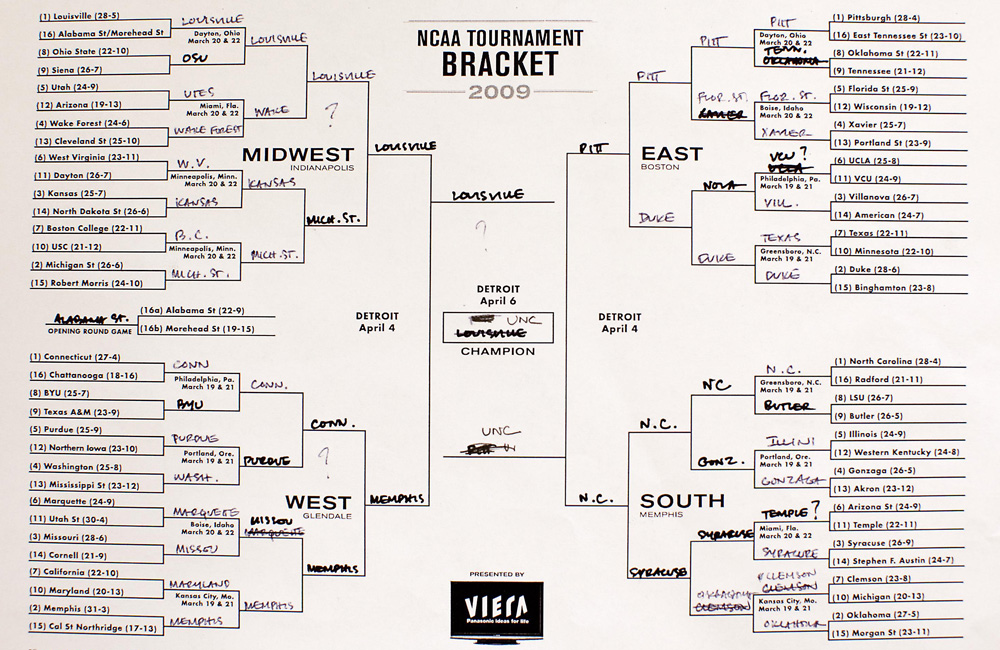
How cool is this? The Commander-in-Chief fills out an NCAA Tournament Bracket for all the world to see. Does it publicly. What would Lincoln have done? More importantly, would Lincoln have taken UNC as well, or gone for the home state Fighting Illini? Is the bracket covered under the Presidential Records Act of 1978? Does it go into the archives?

Seriously though, filling out an NCAA basketball tourney bracket is something millions of Americans do each year. For some, there is no better time in sports than that known as March Madness. I, for one, am not afflicted with the disease--basketball has never been my game (being short and shaped like a pear doesn't help). However, this President clearly enjoys sports and is determined to continue being a fan even from the cloistered Oval Office.

Most of our recent presidents have been sports fans: Nixon, Ford, the Bushes, and Clinton to name a few. Obama fits firmly in that group. What I find intriguing is that he is unapologetic about his preferences (he's an avid White Sox fan and hates the Cubbies) and enjoys the game from a lay person's perspective--he plays pick-up basketball whenever he can, and sat with the fans at a recent NBA game and enjoyed a cold one. Regardless of what your party ID is, if you like sports, you have to admit, that's pretty cool.

Tuesday, February 24, 2009

Presidential Question Time


In the United Kingdom, the prime minister is subject to weekly questions from Parliament. I have often watched those sessions on C-SPAN and marveled that the prime minister sits there and suffers such indignities--American presidents after all refuse to put themselves into such situations. George Washington began--and ended--the practice of going before Congress when he went to discuss the provisions of a treaty his administration had negotiated and vowed never again to return. Other than President Gerald Ford going to Capitol Hill to discuss his pardon of Richard Nixon, presidents, as far as I know, haven't opened themselves up to Congressional questioning.

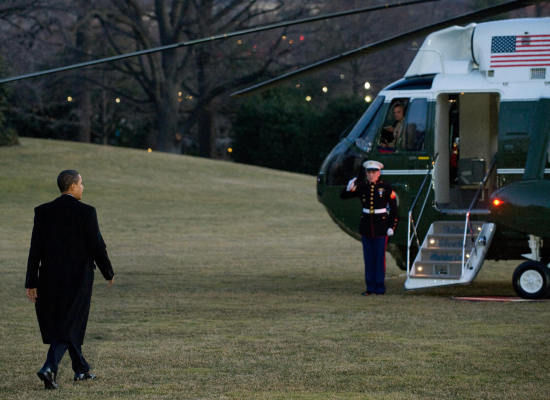
Which is why yesterday's session was so remarkable. President Barack Obama hosted members of Congress in the White House and stood there for over 40 minutes answering their questions in a public forum. President Obama called on his vanquished opponent, Senator John McCain (R-AZ), for the first question. McCain obliged by complaining about cost overruns at DoD and the ballooning price tag for the fleet of helicopters scheduled to replace the current fleet of presidential helicopters known as Marine One when the president flies in them: "Just one area that I wanted to mention that I think consumed a lot of our conversation on procurement was the issue of cost overruns in the Defense Department. We all know how large the defense budget is. We all know that the cost overruns -- your helicopter is now going to cost as much as Air Force One. I don't think that there's any more graphic demonstration of how good ideas have cost taxpayers an enormous amount of money." To which the President responded: "The helicopter I have now seems perfectly adequate to me. (Laughter.) Of course, I've never had a helicopter before -- (laughter) -- maybe I've been deprived and I didn't know it. (Laughter.) But I think it is a -- it is a -- an example of the procurement process gone amuck. And we're going to have to fix it. Our hope is, is that you, Senator Levin, and others, can really take some leadership on this."

The fleet of presidential helicopters IS due for an upgrade--some of the helicopters in the current fleet are over 30 years old--but that is beside the point. The real point is that it is remarkable that this president is willing to publicly answer questions from members of the legislative branch. From both parties, not just his own. No questions pre-screened. And not just "friendly" members of the opposition. My gosh, his surly opponent from the presidential campaign, given first crack. Other critics such as House Minority Whip Eric Cantor (R-VA) were given the chance to throw a ball at the dunk tank. It was a truly unique session and perhaps by the end of his presidency, we may not think of it as unique at all.

Wednesday, January 7, 2009

George W. Bush First Modern President to Lose Secret Service Protection after 10 Years

Because of the 1995 Treasury Department Appropriations Act, presidents are now limited to a total of 10 years of Secret Service protection following their exit from office. Bill Clinton was grandfathered in and will be the last president to have lifetime protection; George W. Bush will be the first former president to which the legislation applies.

This is a bad, bad idea. It was a stupid idea when it was originally written. In a post-9/11 world, it is beyond bad. The 111th Congress needs to rewrite this law. All presidents and their immediate families, regardless of ideology, party, popularity, etc., deserve to have lifetime protection. Some will likely decline as Richard Nixon did in his post-White House years. However, the failed attempt on the life of President George H.W. Bush in 1993 while visiting Kuwait is a stark reminder that ex-presidents and their families will continue to be targets of hostile elements and the criminally insane, in perpetuity.

White House.gov Photo Gallery Feed

White House.gov Blog Feed

White House Flickr Photostream

Site Meter

WIKIO

Wikio - Top Blogs - Politics

Followers