Wednesday, March 18, 2009

Obama Afflcited With March Madness


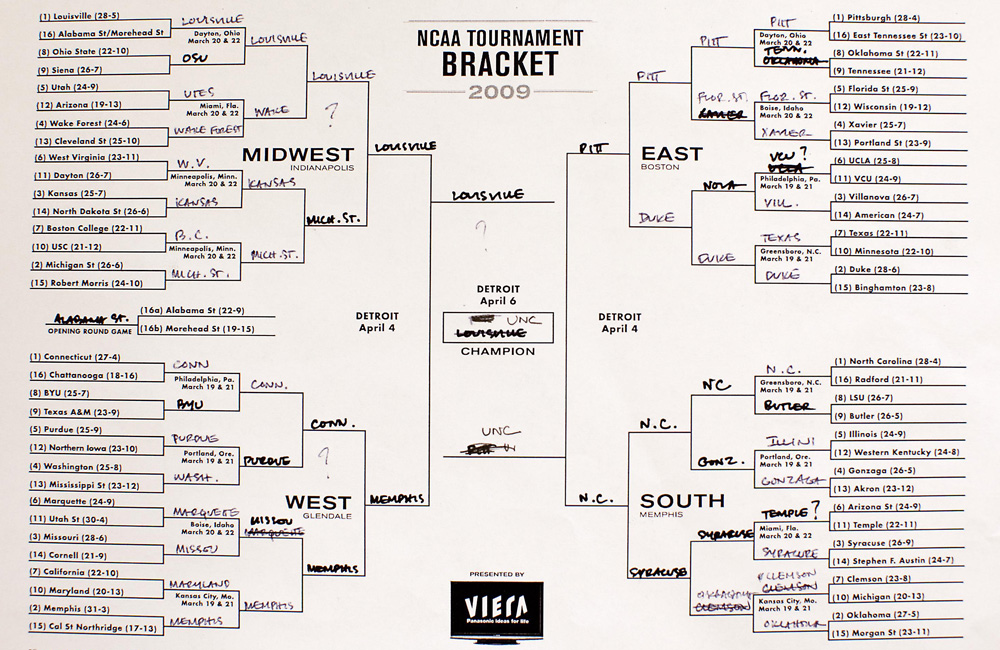
How cool is this? The Commander-in-Chief fills out an NCAA Tournament Bracket for all the world to see. Does it publicly. What would Lincoln have done? More importantly, would Lincoln have taken UNC as well, or gone for the home state Fighting Illini? Is the bracket covered under the Presidential Records Act of 1978? Does it go into the archives?

Seriously though, filling out an NCAA basketball tourney bracket is something millions of Americans do each year. For some, there is no better time in sports than that known as March Madness. I, for one, am not afflicted with the disease--basketball has never been my game (being short and shaped like a pear doesn't help). However, this President clearly enjoys sports and is determined to continue being a fan even from the cloistered Oval Office.

Most of our recent presidents have been sports fans: Nixon, Ford, the Bushes, and Clinton to name a few. Obama fits firmly in that group. What I find intriguing is that he is unapologetic about his preferences (he's an avid White Sox fan and hates the Cubbies) and enjoys the game from a lay person's perspective--he plays pick-up basketball whenever he can, and sat with the fans at a recent NBA game and enjoyed a cold one. Regardless of what your party ID is, if you like sports, you have to admit, that's pretty cool.

Monday, March 16, 2009

The Morphing of the Presidents

This is really cool. Below are a couple of videos of morphing presidents. Ain't technology grand?

UPDATE: I have added a number of presidential morphing video to this post. Enjoy.


Morphing Presidents - Watch the best video clips here

George Washington, Giggling Little Homunculus

A fascinating post over at Millard Fillmore's Bathtub illuminates a boyhood letter from George Washington to fellow Virginian Richard Henry Lee (whom he called "Dickey"), as well as a Grant Wood 1939 painting of a young George with an adult head (a homunculus).

As Ed Darrell points out, Lee and Washington were lifetime friends, and Lee went on to become a signer of the Declaration of Independence, Articles of Confederation, and President of the Continental Congress.

Darrell notes that Washington's childhood was not what you would call Norman Rockwellesque:

"Adult influences in Washington’s early life were not so good as some might imagine. His father died when he was 11. At some point he became estranged from his mother, with her repeated accusations that all her children ignored her (to Washington’s great embarrassment). Washington’s other great adult male influence was his half-brother Lawrence. George was sent to live with his Lawrence, but Lawrence died in 1752, when George was turning 20. Also, Washington got little direction from him after he went to sea with the British. By the time he was 20, Washington was a military commander in the Virginia militia, making adult decisions and living in an adult world. Where did his childhood go? What was it that enabled him to pick himself up and aspire to greatness so often, in so many different ways? What was it bent the twig of the childhood Washington, who grew into the great man the adult Washington became?"

Sunday, March 15, 2009

From Throwing a Javelin to Throwing a Baseball: Two Guys From India Living the American Dream

I love this time of year. Spring is right around the corner. The weather is starting to warm. In the Midwest, we can actually venture outdoors again, take a walk in the sun, maybe even go without a coat. It's also the time for baseball to begin. Major league teams are huddling in Arizona and California and all across this great land, tens of thousands of mostly adult males are preparing for their fantasy baseball drafts.

Being one of those thousands, I came across this great article from CNNSI about two young javelin throwers from India trying to make it in professional baseball as pitchers--a first if it happens. Up until a year ago, Rinku Singh and Dinesh Patel had never played baseball or picked one up. According to the story:

"They were both training to be javelin throwers at a state-run institute in Uttar Pradesh for promising young athletes. Their game plan was simple enough: to win enough medals at national meets to draw the interest of recruiters from the Indian army. That would lead to a career in uniform, starting at the same relative economic level as a U.S. Army GI. That would bring job security -- or at least as much security as can be expected from a job that includes tours in insurgency-wracked Kashmir, where India and Pakistan have fought three wars since 1947. 'If we were in India now,' says Singh, holding his hands up as if wielding a machine gun, curling his left forefinger around an imaginary trigger, 'we'd be fighting terrorists.' (Two of his three older brothers are in the armed services.) Last winter, however, a javelin coach told them about a reality TV show in which the winner could earn big bucks by throwing a ball, hard. With their powerful shoulders, the coach reasoned, Singh and Patel might have a chance. 'We didn't know it had anything to do with baseball or America or anything like that,' says Patel. 'We agreed to compete because of the money.' The Million Dollar Arm was the brainchild of J.B. Bernstein, a sports agent based in Northern California who figured that, by the law of averages, a nation of 1.1 billion people -- most of them nuts about cricket -- must have plenty of young men capable of throwing 90 mph. More than 30,000 Indians signed up to compete across 30 cities. After three rounds of competition, Singh was declared the winner last March, with a top speed of 89 mph. That earned him $100,000 (a king's ransom in his hometown of Bhadohi), a Gatorade shower ('I thought, Why are they pouring juice over me?') and a shot at another $1 million if he could throw three consecutive strikes at 90 mph. (He could not.) Patel, who came in second with an 87-mph pitch, received $2,500, and both entrants earned a trip to L.A., where they would live and train on the USC campus for the next six months before auditioning for major league scouts."

The story gets better. The two moved to the United States where for months they trained with USC Pitching Coach Tom House, who was skeptical anything would come of this. In November of 2008, the unthinkable happened--Singh and Patel impressed a scout for the Pittsburgh Pirates enough that the team signed them to minor league deals.

Anyone who has played the game of baseball knows how truly difficult the game is. The fact that these two guys have accomplished what they have in just a few months is truly amazing. Baseball needs these kinds of inspirational stories with news seemingly breaking everyday about steroids infesting the game over the last two decades and the biggest stars being among the biggest culprits. I know that I will be rooting to see these guys on a major league mound sometime in the future.

Wednesday, March 11, 2009

The Secret Message in Abe's Watch

A secret message inscribed in President Abraham Lincoln's pocket watch was only recently discovered by officials at the Smithsonian Institution. By happenstance, the pocket watch was being serviced by watchmaker Jonathan Dillon when the shop owner burst in with news that the Union Army's Fort Sumter had been attacked, thus beginning the Civil War. Dillon then inscribed the following message inside the guts of the watch: "Jonathan Dillon April 13-1861. Fort Sumpter [sic] was attacked by the rebels on the above date thank God we have a government." Of course, Fort Sumter was actually attacked on April 12, but no matter--you get the point.

Rumors of the hidden message have existed for 150+ years but it was treated as more legend than fact. This artifact of history might have gone undiscovered had Doug Stiles, great-great-grandson to Dillon, not alerted Smithsonian officials to the existence of a letter from Dillon purporting the existence of the hidden message.

Monday, March 9, 2009

Presidential Paramour Portraits

Annie Kevans, a British artist, has created a portrait gallery of presidential mistresses (and in one case mister). I'm sure it's one of the most unique collections assembled regarding the U.S. presidency.

Hat Tip: Political Wire

1600 Quiz: without clicking on the photo, can you identify the woman to the left, which president she was involved with, and the name of her tell-all book.

Saturday, March 7, 2009

DC's 7 Steps to Purchasing a New Car


The frightening state of the economy and American automakers has scared a lot of people of from purchasing a new vehicle. And rightly so. However, there are some tremendous buying opportunities out there for those that can afford a new car.

Cars are a huge purchase and the worst investment you can make. The minute you drive them off the lot you have already lost thousands of dollars. However, most Americans need one for work and home life and that vehicle will be carrying precious cargo--you, family, and friends--so you need to do your homework. Which brings us to step 1.

STEP 1: DO YOUR HOMEWORK

Go to Edmunds.com—the best car info site on the planet. Edmunds has everything you need—reviews, safety info, price guides, dealer incentives, rebates being offered, holdbacks etc. Other helpful vehicle websites include: Kelly Blue Book, NADA, and Cars.com. If it is the beginning of the new year, go to a bookstore and buy the Consumer Reports magazine “Best & Worst Cars”—it’s a quick read and handy resource. It has ratings on every car out there—new and used.

STEP 2: FIGURE OUT HOW MUCH CAR YOU CAN AFFORD

The Internet sources all have financial calculators which will allow you to determine your monthly payment based on rate (you can get current loan rates at bankrate.com), months of the loan, and cost of the car. If you have a car to trade, you can determine a ballpark figure on what you can expect to get from a dealer. Just make sure you can afford the car you zero in on.

STEP 3: BUILD YOUR LIST

Based on these sources and the amount you can afford to pay or finance, start drawing up a list of acceptable cars. Even if buying used, these sources are invaluable and give you all the info you need.

STEP 4: TEST DRIVE

Once you have a list of acceptable cars in your price range, start thinking about test driving. You HAVE to test drive the car before you purchase it—you simply may hate the way it drives. However, you NEVER buy a vehicle right after a test drive. You are simply there to drive, NOT buy. Don't get suckered into the trap of negotiating after a test drive. You have no obligation to stick around--hand them back the keys and scram.

STEP 5: BUILD YOUR CAR

Once you have finished all your test drives, it will probably be apparent which car you want to purchase. If not, add some possibilities by repeating Step 3. Step 5 is where your homework really pays off. Once you target your new car, you build it from scratch using Edmunds or any of the sites mentioned above. Here you determine out what you must have on it, what color you want, and what extras you might like. Edmunds will then calculate the price of these extras and determine what you might expect to pay for your desired vehicle.

STEP 6: START FISHING

This is the really fun part. Go to the manufacturer's website and look for the link that has “dealer locator” or "find a dealer near you." Click on that link and generate a list of 20 or so dealers within 100 miles of where you live. Then email EVERY one of them with a generic email that reads something like this:

"I am interested in purchasing a 2009 Ford Fusion I-4 SE with automatic transmission and electronic stability control this month and am shopping around for the very best price. My desired color is Silver. I live in Somewhere County, Ohio; however, I am willing to drive for the best deal. I am fully aware of the $2500 in customer rebates and the $1000 in auto show incentive Ford is offering.

What I want from you:

1. Cost of the new vehicle including all taxes and fees
2. Your very best estimate of the monthly cost for a 60 month loan

My name and contact info: Joe Shmoe. I strongly prefer email: joeshmoe@myemailprovider.com. Cell phone: 555-555-5555."

If you have a car to trade, ask them to give you a ballpark figure for your trade, assuming the car is in good shape (you can look up definitions of the condition of your trade on any of the sites already mentioned) and have them figure that in to a separate price.

About half of the dealers will ignore you because they know you 1) use the Internet 2) are an informed consumer who knows what he/she wants 3) their profit margin will be very slim. About half will bite, however, especially in this economy. Out of the dealers you email, about 10%-20% will make you serious offers.

You can negotiate by email or phone, but email is better. If negotiating by phone, tell them they MUST email you their best offer. Why? So it’s in writing & you can print it out when you go to close the deal and sign the papers. Also, your local dealer might just meet or beat the best offer you got so be sure you save a hard copy so you can bring it with you when you get to the next step.

STEP 7: REEL ONE IN AND SEAL THE DEAL

Step 7 is the best step of all: buy a car with the satisfaction you got the very best deal possible. It really is this simple. This process could take a few days or a few months, but you will save thousands of $$$ in the end. It can work for used cars too but it is a more complicated process. Regardless of car, you will get a great deal and not even have to step foot in the showroom.

With the woeful state of the economy, it's a buyers' market. There are tremendous opportunities out there for consumers willing to take the time to do their homework.
Friday, March 6, 2009

Obama, Beer, and Some Hoop-Watching


President Obama did something none of us have seen for a longtime--in fact, I can't remember the last time I saw a president do this--he sat in the stands with the fans and watched a sporting event. No luxury box, no cordoned off area--he sat with the crowd to witness his hometown Chicago Bulls get shellacked by the Washington Wizards. President Obama also did something that has brought some controversy to this very cool happening--he drank a beer.

I have mixed emotions about his beverage selection. On the one hand, it is nice to know that the President is similar to so many Americans--he likes to watch sports, relax, and grab a cold one (thank goodness he didn't order wine). If that isn't Americana, I don't know what is. And, I think it's cool that he enjoys being surrounded by people--real people--although I'm sure it drives the Secret Service batty. On the other hand, as much as I, myself, like an ice cold brew in an ice cold mug, as a personal rule, I don't drink in front of my kids, not because I think it will somehow mess them up psychologically, but because I know I am a role model and want to set a good example. Not only was the President having a beer in public, a five year old fan was sitting next to him.

So, if I were to advise the President about the next time he decides to visit a sporting event or any social outing of his choice, I would counsel him to stick to soda. Do the Dew. I'm sure he has been putting in many late nights anyway. The Dew has enough caffeine to keep Rip Van Winkle awake. Better yet, go Code Red--just as much caffeine and oh that delicious cherry flavor. When he gets back to the White House with the cameras off, I'm sure he could find someone to fish out a cold one from the fridge.

GM Hurtling Towards Bankruptcy


Absent additional government aid, it is possible that General Motors, the largest American automaker which began in 1908, will have to file for Chapter 11 protection in short order. This despite the fact that it will have shed around 50,000 jobs, closed 14 plants in the next few years, and eliminated such iconic American nameplates as Pontiac. GM's stock price is in free fall: it closed at $1.86 per share, down 34 cents or 15.5%.

I was at the Cleveland Auto Show Wednesday for NASCAR night. Daytona 500 winner Matt Kenseth was there signing autographs and taking pictures with fans, as were other big names such as Clint Bowyer and A.J. Allmendinger. The crowd was sparse to say the least. The Chrysler exhibit was a ghost town--it gave me an eery feeling. The GM exhibits weren't much better. Of the American automakers, only Ford had a crowd and seemed to spark any enthusiasm.

Socks Clinton Dead at 19

Socks the cat is dead. Yes, I'm a little late to the wake but I thought I'd let my four faithful readers know.

Thursday, March 5, 2009

Obama Chooses Fugate: FEMA to be Plucked From DHS?


President Obama has finally chosen a FEMA Director and by all accounts it was a solid choice. Craig Fugate, Director of Florida's Division of Emergency Management who was appointed and reappointed by Florida's last two Republican Governors, was tapped to head FEMA. Fugate's emergency management background and experience is extensive having navigated Florida through some of her worst hurricane seasons on record including 2004's rampage of Charley, Frances, Ivan, and Jeanne. The choice is in direct contrast to President George W. Bush's selections of Joe Allbaugh and Michael Brown, two political appointees with no emergency management background, to head FEMA from 2001 to 2005. From Allbaugh's cancellation of Project Impact to Brown's (and DHS Secretary Michael Chertoff's) failed leadership during Hurricane Katrina, the lack of experience at the top of FEMA was costly.

The elevation of Fugate to FEMA head and the noticeable absence, as of yet, of a Homeland Security Adviser speaks volumes. My best guess is that legislation will be introduced in short order which will extricate FEMA from DHS and elevate the FEMA Director to cabinet-level status as was the case during the Clinton administration, while at the same time eliminating the Homeland Security Adviser position and Homeland Security Council. I have no inside information, but the smoke signals emanating from the White House seem to indicate a major White House reorganization along these lines is imminent.

Monday, March 2, 2009

Reapportionment 2011: The Red States Shall Rise Again


One of the often overlooked yet crucial determinants of U.S. House electoral success is the decennial process of reapportionment and redistricting. Every 10 years, the Federal Government undertakes the painstaking process of trying to determine how many people live in the United States and where. Based on those figures from the U.S. Census, Congress is then tasked with determining how many U.S. representatives each state will have. Once that is determined, each state, usually the state legislature and governor, perhaps with the aid of a neutral or bipartisan commission, redraws the district lines. It is far from an exact science and is susceptible to the worst forms of political power grabs--the 2003 Tom DeLay-led Texas redistricting being only the latest, most notorious example.


In just a year, the U.S. will begin the process anew. Ken Rudin of NPR has a nice piece on the potential winners and losers of the next census. One thing we know based on crude population numbers: a number of northern states will be giving up seats to those states in the South and West. According to Rudin, here is the best guess of what the seat swap will look like:


Simply based on electoral votes, the GOP will be the big winner in the next reapportionment. Five of the eight states set to gain seats are ruby red led by Texas which will pick up four and Arizona which will gain two. Most of the bleeding comes from the royal blue industrial Midwest and Northeast led by Ohio which will likely lose two. Post-Katrina Louisiana and red-leaning Missouri are the only exceptions. Using 2008 as a guide, if the prediction above holds true, the GOP will gain seven electoral votes just based on reapportionment. For those states losing seats, the battles over which party will take the hit will make for fascinating political theater and brass knuckle politics.

White House.gov Photo Gallery Feed

White House.gov Blog Feed

White House Flickr Photostream

Site Meter

WIKIO

Wikio - Top Blogs - Politics

Followers